Thursday, February 20, 2014

The Citicar and Comuta-Car: 1970s Electric Experiments

A Citicar. 

The 1973 gas crisis ushered in the so called "Automotive Dark Ages". There were good vehicles during the Automotive Dark Ages, but more than a normal proportion of vehicles during the 1973-1984 period were slow, poorly made, or inadvisable. The Citicar was a glorified golf cart that Sebring-Vanguard thought people would embrace due to high gas prices.
The Citicar was made by a company called Sebring-Vanguard from 1974 - 1977, with about 2,300 units produced. The vehicle had full electric propulsion from batteries with a 40 mile range and a 25-38 mph top speed. There was 3-6 horsepower (depending on variant) with a weight of 1,300 pounds. Performance was leisurely and there was no additional power for added features. No radio, no air conditioner, no power anything - just a steering wheel, gas and brake pedals, and a few gauges. There was seating for two on a park bench-style seat. The brakes failed during a Consumer Reports test in 1975.

Variants included the SV-36 (produced prior to December 1974), with a 2.5 horsepower 6 battery motor, the SV-48 (December 1974 - 1976), with a 3.5 horsepower 6 battery motor, and the "Transitional Citicar" (1976 - 1977) with a 6 horsepower 8 battery motor.

See here for a detailed explanation.
1980 Comuta-Car dash.

After the Citicar was discontinued in 1977, another company, Commuter Vehicles, Inc, bought the rights to produce the Citicar. They made an updated version from 1979 - 1982, known as the Comuta-Car. It had the same 6 horsepower motor as the "Transitional Citicar" - that made up half of the car's weight - but a few changes were made from the Transitional Citicar. The vehicle had huge energy absorbing bumpers, but it wasn't safe, even by 1980 standards. The body style was also slightly changed.

The Comuta-Van was a 12 horsepower "van" version made from 1977 - 1979.

There's even a Yahoo group for Citicar/Comuta-Car/Comuta-Van owners.

Wednesday, February 12, 2014

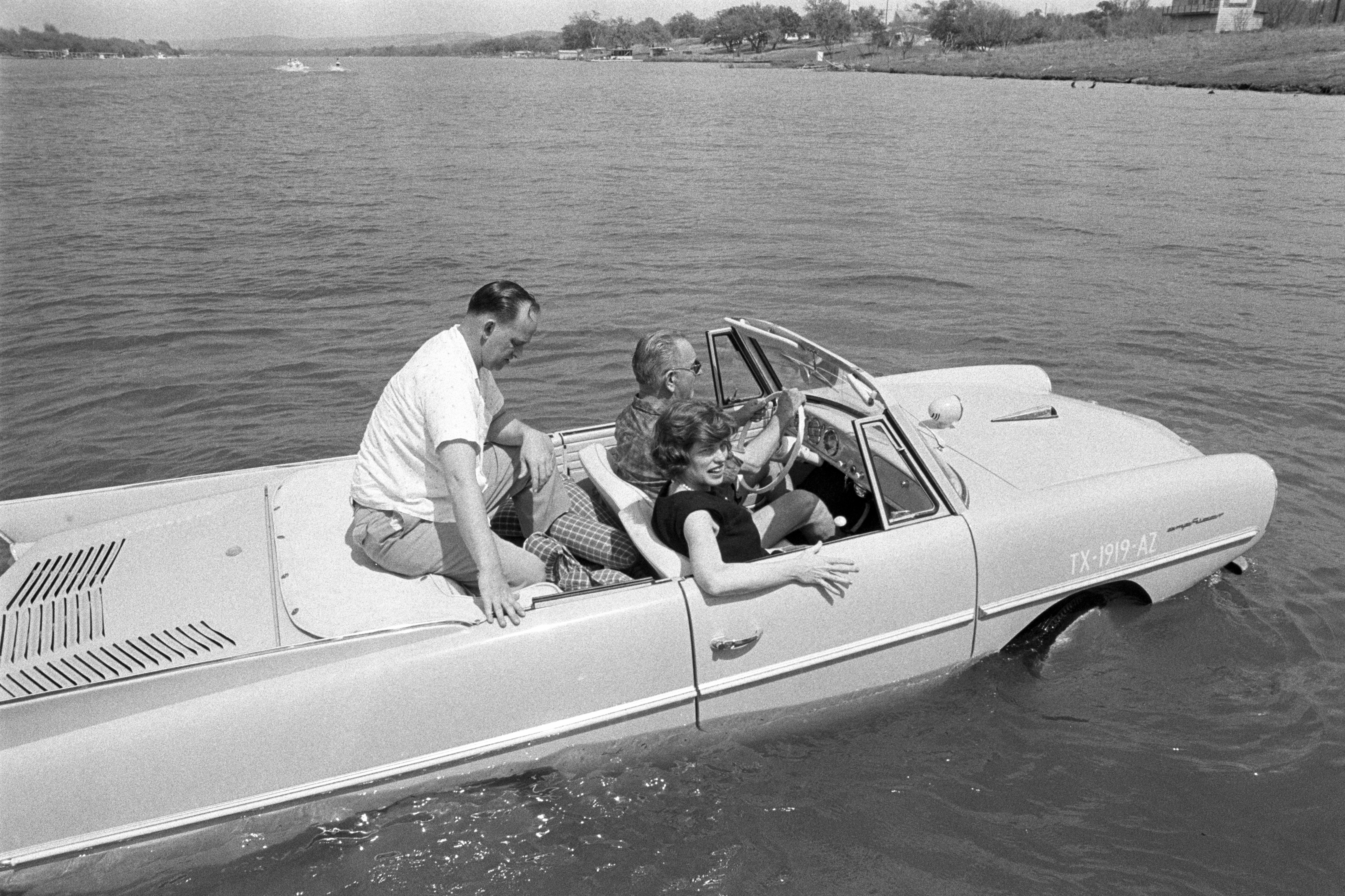
The Amphicar: A car and a boat!

The interior of an Amphicar, from one of my 2005 pictures.
LBJ on a car-boat on April 10, 1965. 

A car that can swim. One off concept, right? Weird Soviet car made for only six months? No. The Amphicar was made for four years (1961-1965), and titled for 3 more. It was made by Quandt Group, a German company. Nearly 4,000 are still on the road/water, and there's even an owner's club. Only available as a soft top convertible, it was a decent quality vehicle for the 1960s, and watertight if well maintained. It had a top speed of 7 mph on the water. The 43 hp engine - from a Triumph Herald 1200 - provided decent if lackluster performance on land, but performance was sufficient to be street legal, with a top speed of over 70 mph. Some owners upgrade their 43 hp engines to 75 hp engines from later Herald models, giving it improved performance. It is one of the most successful amphibious vehicles ever made.

Its tail fins were higher than any other vehicle ever produced, even higher than the 1959 Cadillac!


Tuesday, February 11, 2014

The Velorex: More Eastern Bloc WTH

The Velorex - photo by Pavol Freso.

The Velorex was a Czechoslovakian car, but the body was made of vinyl (called "Igelit") stretched over steel tubing. Same construction as a tent. Made by its own company, founded from scratch by two brothers, the Velorex was made from the mid 1950s to 1971. Early models were called Oskar, but the Velorex name was introduced just a few years into production. Production was limited - only 15,300 were made. It was a cross between a motorcycle and a car, and was designed for the disabled. The price was attractive - for the price of a typical car, you could buy about four Velorexes.


Variants included the Oskar 54 (mid 1950s), Velorex Oskar (c. 1956-late 1950s), Velorex 16/250 (late 1950s to 1960s), Velorex 16/175 (1963-1971), and Velorex 16/350 (1963-1971). The 16/350, the most powerful variant, had a production of 12,000 units that made up 78 percent of Velorex production. 


It had three wheels - two front, one rear. It featured motorcycle engines with 9 to 16 horsepower, depending on the variant.

The Velorex required only a motorcycle driver's license prior to 2000, making it an attractive option for those who wanted an enclosed car but lacked the wherewithal to get a full driver license. The cars were reliable; in 1996, 62.5% ever made were still on the road, at 25 to 40 years old.


Tuesday, February 4, 2014

The Acura ZDX: A Luxurious, Reliable, Safe Oddball


Many unusual cars are hard to live with. They have styling that cuts into occupant space, uncomfortable seats, overpowered or underpowered engines... stepping out of the norm in all the wrong ways. They may be unreliable, seeming one step removed from their first prototype, or just simply worn out from age. And most of them, being very old, are unsafe. Forget airbags; many old unusual cars lack even a seat belt.

The Acura ZDX is a unique case - the unusual case of an unusual car that is easy to live with. It launched in December 2009, around my 17th birthday, so I remember when it launched and can give you a unique perspective on it. I haven't ridden in one yet, but my days are likely numbered until I do.

Acura is a luxury vehicle brand, but being owned by Honda, they are liable to release one of a kind cars. The Acura ZDX was somewhat similar to the BMW X6, but was built off of an MDX SUV platform as opposed to a car platform. It had an odd look, sort of like a coupe-station wagon-SUV hybrid, yet it had four doors.

Behind its odd, one of a kind looks, it was a traditional early 2010s luxury SUV. It had all of the features you would expect in a luxury SUV. It got good reviews, but was marked down for its utility - the low roof limited space to load cargo. Being a Honda, it was very reliable and very safe.


Wednesday, January 29, 2014

The ZAZ Zaporozhets subcompact: A Soviet Car with Several WTH Features

When was the last time you rode in a car with a hole in the floorboard? Probably never, but it's entirely possible, say, if it was a very old car with a rusted out floorboard. Perhaps the hole even had an ad-hoc covering over it. There was a car with a hole in the floorboard right from the factory...


Vladimir Putin with his ZAZ-968. Photo by www.kremlin.ru
The ZAZ interior. One of my 2005 pictures.


The ZAZ Zaporozhets subcompact was produced from 1966 to 1994, in numerous variants. (An earlier variant was produced from 1960-1969, but this article is on the second generation models) You won't see a Zaporozhets simply called by its name. These models were produced as the ZAZ-966 (1966-1972), ZAZ-968 (1971-1978), ZAZ-968A (1973-1980), and ZAZ-968M (1979-1994), each version updated and modernized over the last. This is the first point of unusuality. Normally, when a car is redesigned, it is totally replaced, not produced concurrently with an older version. (Some other vehicles have used this practice, but the majority haven't)

The Zaporozhets also came with "trim lines", but they were not trim lines in the usual sense. The trim lines had unusual names (B, B2, A, and others for the 968) and were designed for people with missing limbs. There were variants for people missing one foot, both feet, and arms. These were sold to the disabled with permission from the Soviet government, many to veterans with war related injury. An additional variant had a less powerful engine than the base variant. 

And then there was the fishing hole. On the passenger side floorboard, there was a hole drilled with a cover over it. The idea was to park on a frozen lake or body of water, dig a hole in the ice, and fish while in your car. This was the only vehicle ever produced with a hole intentionally put on the bottom of the car. 

Fishing hole not included. 


About This Blog

This blog covers cars that are unusual.

Tuesday, January 28, 2014

The Mazda Roadpacer: A Big Luxury Car with a Little Rotary Engine


 Photo by Japanese Wikipedia user Taisyo.
I say "Mazda", you say "zoom zoom". Mazda makes a broad line of small and midsized cars and SUVs, with an emphasis on sport and driving dynamics. Perhaps their best known vehicles are their series of rotary engined sports cars. The rotary engine has been wholly confined to the RX series sports cars since about 1980, but in the 1970s Mazda slapped a rotary engine in pretty much anything that they made.
During this time, Mazda also built a luxury car, as expensive as a contemporary Cadillac Fleetwood. The Mazda Roadpacer wasn't particularly big by today's standard - my 2011 Honda Accord V6 has about the same weight - but it was huge by Mazda standards, and being sold only in 1970s Japan, it was a very large vehicle for the time and place. The Roadpacer wasn't even built by Mazda - it was a re-badged Holden Premier, a full size Australian sedan. Mazda took the Premier and fitted a 130 horsepower rotary engine and equipped the car to the gills, including automatically locking doors, a speed warning system that activated at 56 mph, an in-car Dictaphone system, and a stereo that could be controlled from front and back seats.

Produced from 1975 to 1977, only 800 cars were sold, and most were sold to Japanese government officials. Most of these 800 were crushed in later years, making the Roadpacer extremely rare. The car's failure can be attributed to various factors: the price ($10,000 at the time) and fuel consumption (9 mpg, about like a Hummer H2) in the wake of the first gas crisis. The vehicle was also slow, saddled with slow acceleration to a top speed of a tepid 103 mph.

Why would Mazda sell a slow, gas guzzling, Australian built luxury car? Competition. Japanese luxury cars only reached the USA in the late 1980s, but have been sold in Japan for as long as cars have been sold there. Toyota, Nissan, Mitsubishi, and even Isuzu had luxury models out by 1975.